01
Two-year stay-back visa
Two-year stay-back visa for non-EU graduates — one of the longest in Europe — with full work rights and no employer sponsorship needed.
Ireland is Europe’s English-speaking gateway and the European HQ for Google, Meta, LinkedIn, Pfizer, and Apple — making it a magnet for ambitious Indian students. With a 2-year post-study stay-back, top-100 universities like Trinity College Dublin, and tech-industry recruitment pipelines, Ireland offers one of the strongest education-to-career routes in Europe.
 Ireland · EU Member
iSTEP’s Ireland education consultants work one-on-one with academically strong students — from shortlisting Trinity, UCD, and the University of Galway to scholarships, the AVATS visa application, and pre-departure. Counselling is free and based at our Nehru Place office in Delhi.
Click here for a free consultation →Ireland ranks among the top destinations for Indian students pursuing global higher education. Here are the key reasons students choose Ireland in 2026.
Two-year stay-back visa for non-EU graduates — one of the longest in Europe — with full work rights and no employer sponsorship needed.
Dublin is the European HQ for Google, Meta, LinkedIn, Apple, Pfizer, and Microsoft, providing direct hiring pipelines from Irish universities.
Ireland’s universities rank in the global top 1% — Trinity College Dublin (#75), University College Dublin (#125), and University of Galway (#284) per QS 2026.
High visa success rate of 99%+ for Indian students with properly prepared documentation, among the highest of any major study destination.
English-speaking, EU-member country giving access to 27 European nations during studies through visa-free Schengen travel.
Lower cost of living than the UK, with strong scholarships from Irish universities specifically targeting Indian students.
iSTEP partners with leading institutions in Ireland ranked among the world's finest by QS Rankings 2026. Each university below offers competitive scholarships and clear pathways for high-achieving Indian students.
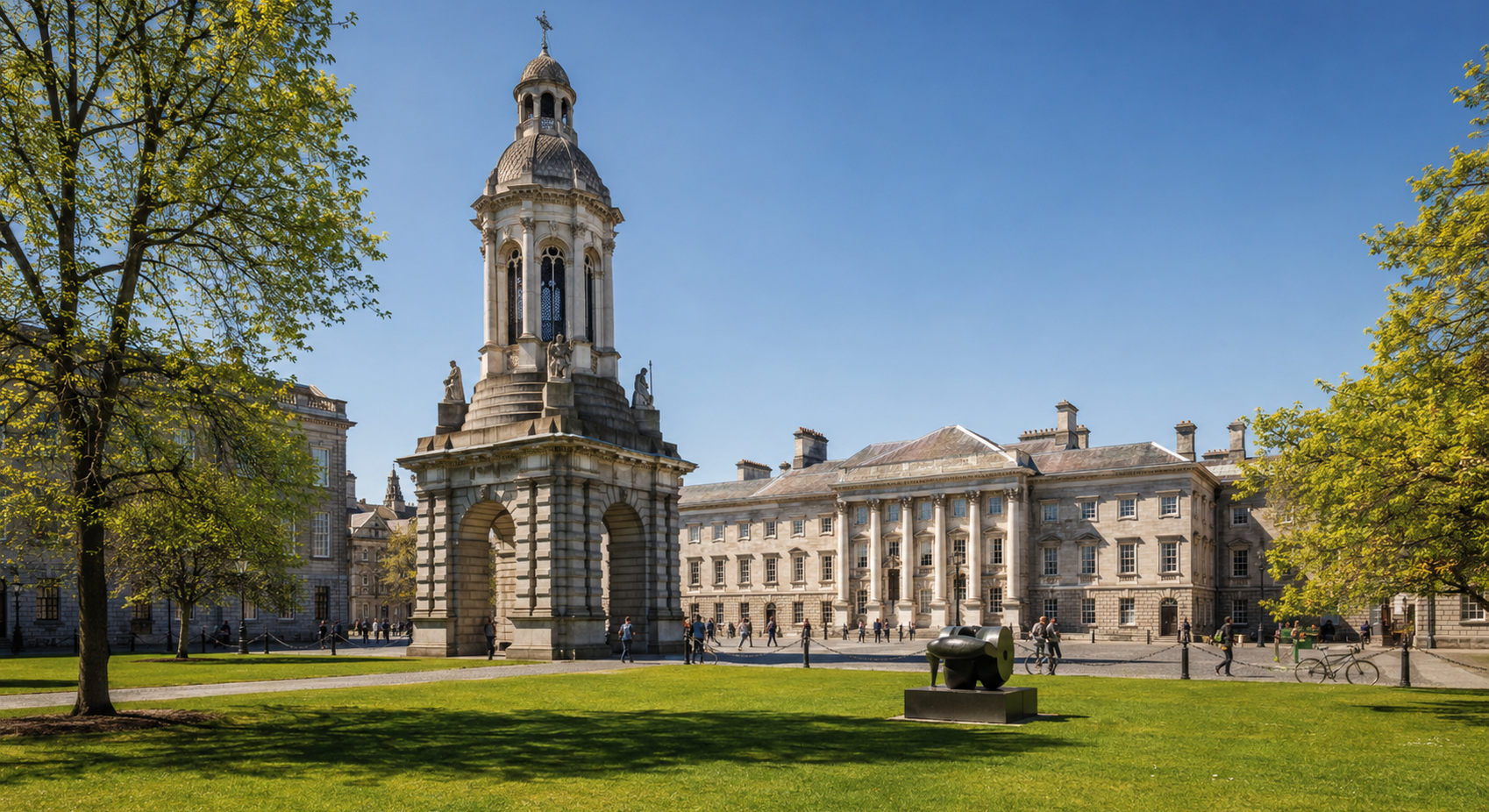
Ireland’s oldest and top-ranked university (#75 globally, QS 2026). Founded 1592. Strong in literature, history, computer science, business, and medicine. Nobel laureates among its alumni.
Ranked #125 globally and in the world’s top 1% (QS 2026). Largest Irish university by enrolment. Strong in business (Smurfit School), engineering, agriculture, and veterinary sciences.
Distinguished for research impact and forward-thinking approach. Ranked #284 globally (QS 2026). Strong in biomedical sciences, sustainable energy, and the arts.
Ranked #273 globally (QS 2026). Strong in food science, dentistry, pharmacy, and business. First Irish university to earn five-star QS rating across teaching and employability.
Ranked #471 globally. Strong industry partnerships with Dublin’s tech sector. Excellent for computing, business analytics, communications, and biotechnology.
Modern research-focused university with strong industry placement program. Ranked top 500 globally. Notable for engineering, business, computer science, and health sciences.
Internationally recognised health-sciences university focused on medicine, nursing, pharmacy, and physiotherapy. Strong international student community.
Research-intensive university in Co. Kildare with strong programs in arts, social sciences, computer science, and business.
Ireland’s largest university, formed from the merger of major Dublin institutes. Strong in applied technology, engineering, computing, business, and creative arts.
Cork and Kerry-based university with applied focus on engineering, computing, business, and biosciences. Strong industry partnerships in the Munster region.
Indian students most commonly pursue these programs at Ireland universities, based on graduate employment outcomes and post-study work eligibility.
The total cost of studying in Ireland for Indian students includes tuition, living expenses, and visa-related fees. Below is an indicative breakdown for international students starting in 2026.
Approx. ₹9L – ₹23L. Engineering, sciences, and medicine cost more than arts and humanities.
Approx. ₹9L – ₹32L. Trinity, UCD, and specialised programs (data science, FinTech) at the higher end.
Approx. ₹11L – ₹14L per year. Irish authorities require €10,000/year proof for student visa.
Approx. ₹7.5L – ₹9L per year. Cork, Galway, and Limerick are significantly cheaper than Dublin.
Mandatory for all international students before visa application.
Approx. ₹5,500 – ₹9,200. Single-entry €60, multiple-entry €100.
Paid on arrival in Ireland to register for an Irish Residence Permit.
Costs are indicative and vary by university, program, and city. iSTEP counsellors provide university-specific cost estimates during your consultation.
Ireland universities offer multiple admission cycles each year. Knowing your target intake helps you start application preparation 8-12 months in advance.
September Intake (Autumn). Largest intake — 95% of programs available. Applications open the previous October. Deadlines typically March–June.
January Intake (Spring). Selected programs at most universities. Applications close August–October of the previous year.
The Ireland student visa requires careful documentation and timing. iSTEP guides students through each step below, achieving high approval rates through thorough preparation.
Accept your university offer and pay the full first-year tuition fee. Irish universities require full tuition payment before issuing the official Letter of Acceptance needed for visa application.
Show proof of €10,000 minimum funds for living expenses in your or sponsor’s account. Provide 6-month bank statements, sponsor affidavit, ITR returns, and property documents if applicable.
Indian applicants must submit a TB test certificate from an IOM-approved clinic in Delhi, Mumbai, Chennai, or Kolkata, completed within 6 months before application.
Apply online through the AVATS portal. Pay the €60 (single-entry) or €100 (multiple-entry) fee. Submit supporting documents to VFS Global centre in India within 30 days.
Standard processing time is 4–8 weeks. After visa approval, book your flight, arrange accommodation through university or private rentals, and register with the Garda National Immigration Bureau within 90 days of arrival.
Ireland universities and the government offer scholarships specifically for international students from India. iSTEP's scholarship-focused counselling helps high-achievers secure significant funding.
Government of Ireland International Education Scholarship — €10,000 plus full tuition waiver. Highly competitive, awarded to ~60 international students annually.
Trinity College Dublin Global Excellence Scholarship — up to 50% tuition fee waiver for high-achieving Indian undergraduate and postgraduate students.
UCD Global Excellence Scholarship — €5,000 to full tuition fee waiver based on academic merit. Specifically targets Indian and South Asian applicants.
University of Galway India Scholarship — €2,000 to €5,000 tuition fee discount for Indian students at undergraduate and postgraduate levels.
DCU St. Patrick’s Day Scholarship — full tuition waiver for high-performing Indian students in specific tech programs.
University College Cork International Scholarships — €1,000 to €5,000 for Indian students across various programs.
Walsh Fellowships — fully-funded PhD scholarships in agricultural and food science research at Teagasc.
KEMMY Business School Scholarship at University of Limerick — €5,000 for high-achieving Indian MBA and Master’s in business candidates.
Ireland’s Third Level Graduate Programme allows non-EU graduates to remain in Ireland for up to 2 years after completing their degree (Stamp 1G permission) — without requiring sponsorship or job offer. During this period, graduates can work full-time in any sector and many transition to skilled employment with Dublin’s tech giants. Common pathways include the General Employment Permit, Critical Skills Employment Permit (for high-demand occupations including IT, engineering, finance, and healthcare), and eventually long-term residency leading to Irish citizenship after 5 years. Indian graduates of Irish universities have particularly strong placement records at Google, LinkedIn, Pfizer, Microsoft, and Accenture’s Dublin offices. iSTEP’s counsellors help students choose programs aligned with Critical Skills occupations for the strongest post-study career outcomes.
Direct partnerships with Trinity College Dublin, UCD, and the University of Galway — Ireland’s top three universities — for priority application support.
We navigate the unique requirements including TB test, €10,000 financial proof, and AVATS application process — Ireland-specific challenges.
We focus on placing students at Ireland’s top-ranked universities with strong tech-industry pipelines, not high-volume mass placements.
Ireland has lesser-known scholarships specifically for Indian students. We identify the strongest matches based on your academic profile.
Dublin housing is competitive — we provide guidance on student accommodation, banking, and post-arrival immigration registration.
We recommend programs aligned with Ireland’s Critical Skills list for strongest post-study work and PR outcomes.
Quick answers to the most common questions from Indian students and parents considering Ireland.
iSTEP is among Delhi’s leading Ireland education consultants, with direct partnerships with Trinity College Dublin, University College Dublin, and the University of Galway. iSTEP’s High Achievers’ Program serves academically strong students seeking placement at Ireland’s top universities with focus on scholarships and career outcomes. Our Nehru Place office offers free counselling — book a consultation to discuss your eligibility.
Annual costs range from approximately €22,000 to €50,000 (about ₹20L to ₹46L) for postgraduate students in Dublin, including tuition (€10,000–€35,000), living expenses (€12,000–€15,000), health insurance (€500–€800), and visa/immigration fees (€300–€400). Costs outside Dublin (Cork, Galway, Limerick) are 25–30% lower. Trinity and UCD sit at the higher end.
For globally competitive programs, Trinity College Dublin (#75 QS 2026), University College Dublin (#125), and the University of Galway are the top choices. For business and analytics, UCD Smurfit and Trinity Business School lead. For tech-industry careers in Dublin’s European HQ ecosystem (Google, Meta, LinkedIn), all top Irish universities have strong placement records. Smaller universities like DCU and University of Limerick also have excellent industry-aligned programs.
Ireland’s Third Level Graduate Programme (Stamp 1G) allows non-EU graduates to stay and work in Ireland for 2 years after completing a master’s or PhD (1 year for bachelor’s). This is among the longest stay-back permissions in Europe. During this period, graduates can work in any sector with full rights. Many transition to Critical Skills Employment Permits (in IT, engineering, finance, healthcare) and eventually to Irish long-term residency.
Yes — Ireland offers several scholarships specifically for Indian students. The Government of Ireland International Education Scholarship covers €10,000 plus tuition. Trinity, UCD, and Galway offer 25–50% tuition fee scholarships for high-achieving Indian students. The Walsh Fellowships fully fund PhD research. iSTEP helps students target the right scholarships based on academic profile, program, and university preferences.
Ireland’s D-type student visa approval rate is approximately 99% for Indian students with properly prepared documentation — one of the highest among major study destinations. Common rejection reasons include incomplete financial documentation (must show €10,000+), missing TB test certificate from approved clinics, and gaps in the academic history without proper justification.
Irish master’s degrees are typically 1 year (12 months) full-time — similar to the UK and shorter than the US or Australia. Research master’s programs run 1–2 years. This means significant cost savings: a Trinity or UCD master’s plus 2-year stay-back gives 3 years total in Ireland with strong career outcomes — competitive with longer programs in other countries.
Most Irish universities require IELTS 6.5 overall with no band below 6.0 for undergraduate and postgraduate admission. Some specialised programs (medicine, journalism, law) require IELTS 7.0+. Trinity College Dublin and UCD accept PTE Academic (61–65), TOEFL iBT (88–90), and Cambridge English. Indian students whose previous education was in English medium can sometimes get IELTS waiver — universities review on a case-by-case basis.
For September 2027 intake, start in October–December 2026 — Irish universities open applications about 10–12 months in advance. Top programs at Trinity and UCD have deadlines as early as March 2027 for September intake. For January 2027 intake, apply by August–October 2026. iSTEP recommends beginning university shortlisting 12–15 months ahead to allow time for IELTS, SOP writing, and TB test scheduling.
Yes. Students on Stamp 2 (Ireland’s student permission) can work up to 20 hours per week during term and 40 hours per week during holidays (June–September and 15 December–15 January). Common student jobs include retail, hospitality, on-campus roles, and internships related to your course. The minimum wage in Ireland is €12.70/hour (2026), so part-time work can cover most living costs in non-Dublin cities.
For many students, yes. Ireland is an English-speaking EU member and the European base for Google, Meta, LinkedIn, Pfizer, and Apple — so graduates step into a strong tech, pharma, and finance job market. Combined with a two-year stay-back visa and globally ranked universities like Trinity College Dublin and UCD, it offers a clear study-to-career pathway. It is especially worth it for IT, data, pharma, and business students who plan early and target scholarships, which is exactly what iSTEP optimises for.
In many cases, yes. Irish universities frequently accept a Medium of Instruction (MOI) letter from Indian students whose prior education was in English, or alternatives such as PTE Academic, TOEFL iBT, and the Duolingo English Test. Acceptance varies by university and programme, so iSTEP confirms each institution’s English-waiver policy against your profile before you apply.
Yes, through a structured route. After graduation you move to the Stamp 1G stay-back permission (up to two years) to find work, then to an employment permit — the Critical Skills Employment Permit is the fastest path, available for in-demand occupations. After holding qualifying permits you can apply for Stamp 4 (long-term residence) and eventually citizenship. iSTEP helps students choose courses aligned with Ireland’s Critical Skills Occupations List.
Irish universities generally accept reasonable academic gaps — commonly up to two years for undergraduate entry and longer for postgraduate study when justified by work experience or a clear, documented reason. A strong statement of purpose explaining the gap matters more than the gap itself. iSTEP helps students present gaps as a strength, backed by relevant experience.
Fully-free study is rare, but meaningful funding exists. The Government of Ireland International Education Scholarship offers full fee waivers plus a stipend, and universities including Trinity, UCD, and University of Galway offer merit scholarships of 25%–100% of tuition for strong applicants. Most students combine a partial scholarship with an education loan. iSTEP helps high-achievers target the strongest scholarship matches for their profile.
Book a free 1-on-1 counselling session with an iSTEP expert. We'll review your profile, recommend universities, and create a personalised application strategy — at no cost.